Initial Level
The GCSE initial assessments we use at Pass calculate your starting point so that you can target your learning to the areas that require the most improvement.
Pass offers free GCSE initial assessments in Maths, English and Science engineered to give a true measure of ability using weighted questions, while laying the groundwork for tracking progress over time.
Pass offers free GCSE initial assessments in Maths, English and Science engineered to give a true measure of ability using weighted questions, while laying the groundwork for tracking progress over time.
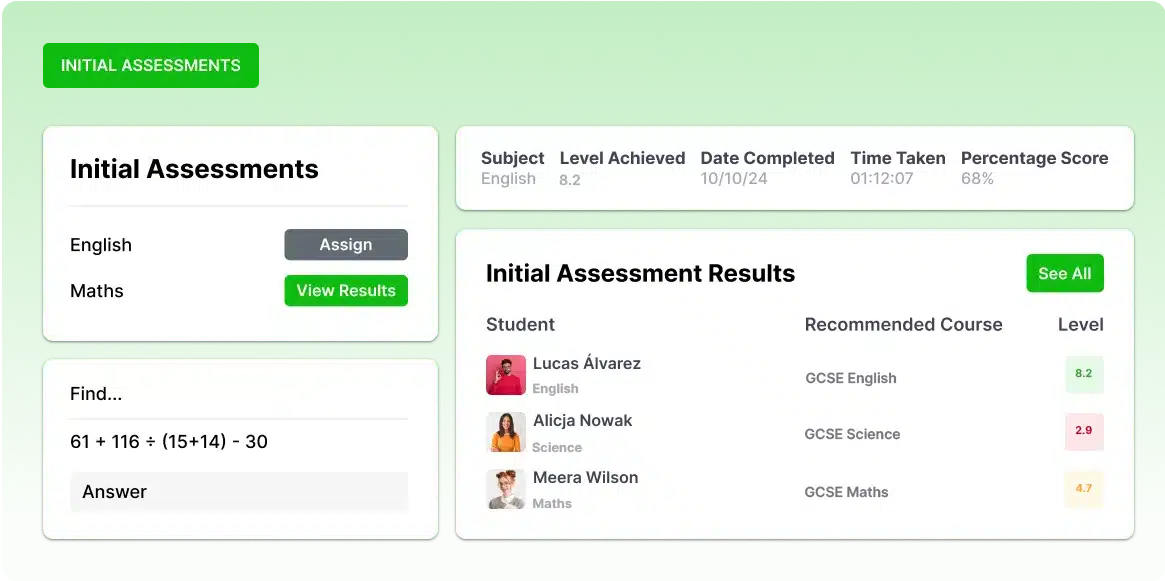
The GCSE initial assessments we use at Pass calculate your starting point so that you can target your learning to the areas that require the most improvement.
GCSE initial assessments are free for everyone at Pass, giving you the baseline levels for all your learners easily.
We meet all DfE standards and guidelines using our initial assessments, so that your learners get the best possible support in their education.
The GCSE initial assessments in Maths, English and Science act as diagnostic tools to establish where a learner currently stands. Each question is carefully chosen and weighted based on its difficulty and relevance to the GCSE curriculum, ensuring the result is a true reflection of ability rather than just a raw score.
That result becomes the learner’s Current Level – a living measure that updates every time they complete a practice question or mock exam. This gives educators a reliable, up-to-date picture of progress for all of their learners. The Current Level updates through our GCSE diagnostic tests along with past papers and practice questions.
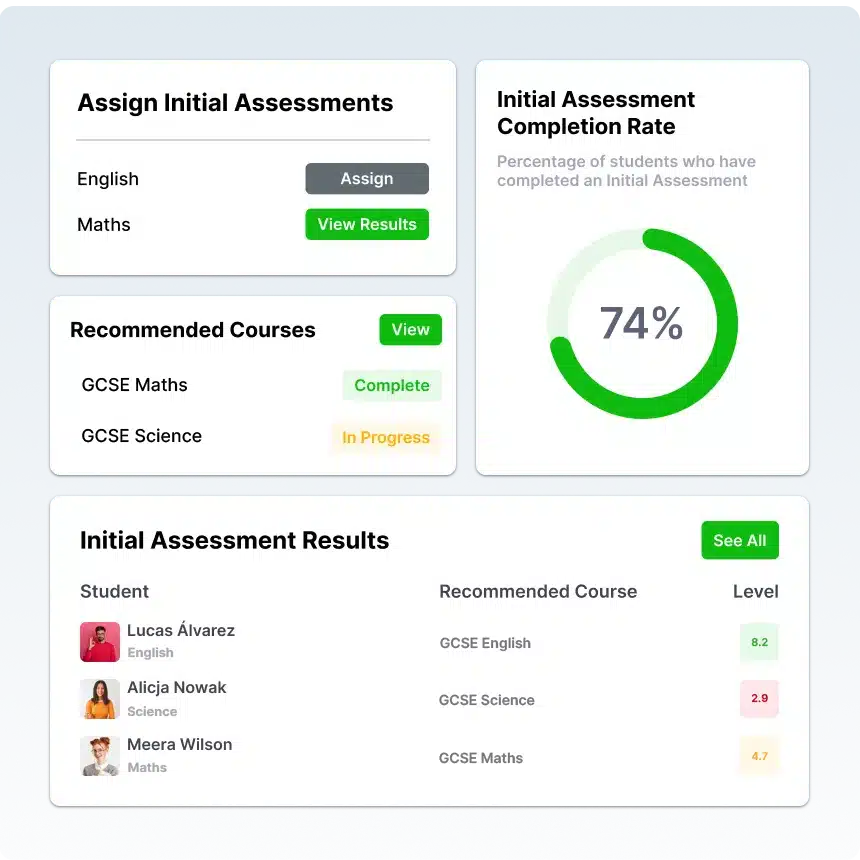
The GCSE initial assessment tools are built in line with DfE guidelines, so you can be sure that Pass is the best option for your learners.
These advanced Maths diagnostic assessments and English diagnostic assessments go beyond simply establishing a learner’s Current Level – they also generate a personalised learning plan tailored to individual needs. All results and data can be exported as Excel or PDF reports as required for your needs.
‘Current Level’ is the measure of a learner’s attainment within the Pass GCSE software. It’s first calculated using the initial assessment result and then refreshed each time a learner completes a new question or paper.
At the heart of this is a unique algorithm that moves well beyond a basic percentage score. It factors in question difficulty and applies specific weightings, placing greater emphasis on performance in harder questions while making smaller adjustments for gaps in easier areas. This produces a more accurate reflection of true ability, ensuring learners are matched to the right course and that any knowledge gaps are properly addressed.
What makes the Pass approach truly distinctive is its ability to identify strong learners who may still have notable gaps in their knowledge – something conventional assessments often miss.
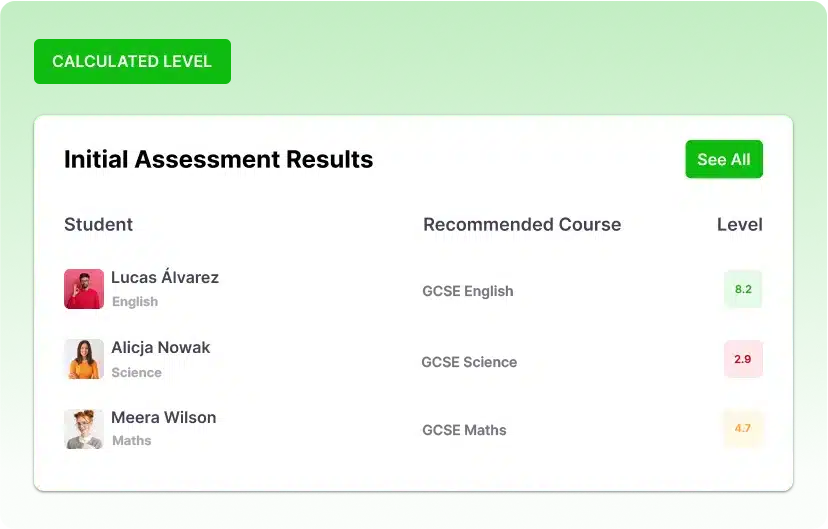
The learner is showing limited understanding of the material and is currently at a Grade 1 standard.
The learner is showing signs of understanding but has lots of areas to improve. They are currently at a Grade 2 level.
The learner is currently working at a Grade 3 standard, but can easily be on track for a Grade 4 or above by working with Pass.
The learner is showing solid understanding of several key parts of the curriculum, but still has areas they can improve on.
The learner is currently on track for a high pass, working at a Grade 5 level. Continuing to work with Pass GCSE will help them improve to higher levels.
The learner has a good understanding but improvements can still be made. They are currently at a Grade 6 level.
The learner is showing really good understanding of the material and is working at the level of a Grade 7 student.
The learner is operating at an excellent standard, with a predicted grade of an 8. Only a few small improvements can be made!
The learner is ready for the exam!

The Functional Skills Maths and English initial assessments and diagnostic tests are available at no cost whatsoever, as well as the GCSE diagnostic tests. Training providers, colleges and other educational institutions can make full use of the service completely free of charge, with no limits on usage.
The GCSE initial assessments contain varied question styles depending on the subject. Some are shorter and only require one word answers, whereas other questions are longer and require a more detailed response.
The Pass group of brands offers more free resources than any other provider in the sector. The ethos behind this is simple – to give learners the greatest possible access to free GCSE resources, removing the barriers that might otherwise stand in the way of achievement.
The levels are an indication to you and your learners of what level they are currently working at. Level 1 means your learner is working at a Grade 1 level, whereas Level 2 means your Learner is working at a Grade 2 level etc.